The Big Stack Paradox: Why More Money Makes You Worse
Last week, I had a poker night, it all started so well. I won the first two hands, then a few more and after a while I was what is known as the Big Stack Bully.
30 minutes later I had lost. I got sloppy. I made calls I wouldn't have made an hour earlier. Because I had more chips I took bigger risks, I chased hands I should have folded. The early success made me play worse.
I don't like losing, but I like learning. Here is what I learnt and why it matters to startups and scaleups with a sudden influx of cash in the bank.
In poker, the big stack almost always wins, note: almost.
When you're sitting behind a mountain of chips, you can play loose. Bad call? No problem. Speculative bet? Why not. You can afford mistakes.
BUT when you're short-stacked and down to your last few chips, you need to play perfectly. Every decision matters. One mistake, or bit of bad luck and you're done.
Yet in startups, it's the opposite.
The well-funded big stack often loses (Allplants, Bulb, Babylon Health, Made.com). And the bootstrapped short stack startup, if they survive, often builds something more unbreakable and more valuable.
Why Lots of Cash Can Be a Very Bad Thing
In poker, you're playing against other players. More chips mean more chances to outlast them. In startups, you're playing against the whole market not just a few people. Having £3M in the bank doesn't change whether your product works or means that your unit economics stack up or whether your brand appeals.
What too much cash actually does is allow you to avoid learning what you need to know.
When you're flush with capital:
You end up with a bloated workforce by hiring three people when you need one
You test six marketing channels and become masters of none
You launch into new sales channels before you are ready
You build polished products that still don't solve a real problem
You paper over bad unit economics or worse, ignore them, instead of fixing them
This sort of sloppy thinking compounds dangerously fast.
The Short Stack Advantage
A typical startup founder who does not have lots of money in the bank is playing a different game and learning fast.
A short stack founder:
Hires only when desperate and only when they understand the job themselves as they have been doing it for a year
Masters one channel completely, because they can't afford to test others and intuitively understand the 80:20 rule
Talks to every customer, because they can't afford market research agencies or data
Proves their business model works before scaling by demonstrating solid unit economics and evidence of demand or better actually generate profits
So if you've just raised a big round, especially if it's more than you actually need (hello overfunded crowdfunds), here's how to maintain the advantage of short-stack discipline:
Consider the merits of keeping the workforce lean vs a big team, even if you can afford it
When launching into new products and new channels make sure you are winning in the ones you are already in, and if you are not recognise you are actually pivoting not scaling
Protect your cash. If you are still pre-profit, try and extend your runway, and in management meetings talk about profits as much as you do about revenue
If you are already profitable, then ringfence some cash for emergencies and execute only with the remainder
If you have the advantage of a big stack, you can afford to lose a few hands but never go all-in and play with discipline. When your luck runs out, it will be your smarts and lessons learnt, not your cash, that will save you.
Otherwise, you will be like me the other night, confident enough to make a few bad calls, play a few bad hands and suddenly have neither the time nor the luck to rectify those mistakes.
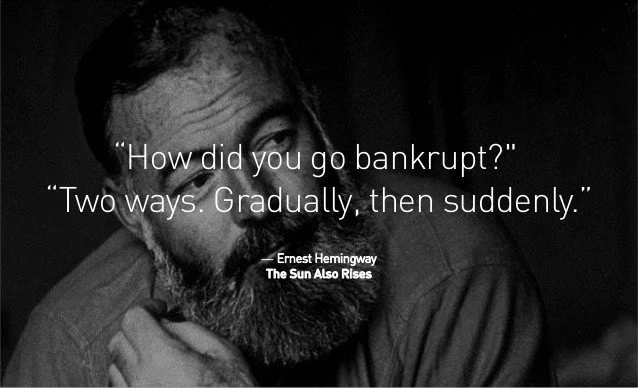
“
”How did you go bankrupt?” Bill asked.
”Two ways,” Mike said. “Gradually and then suddenly.”
”